- Home
- Wild Plant Foods
- Palm Tree Fruit
Harvesting Palm Tree Fruit from the Wild Desert Fan Palm
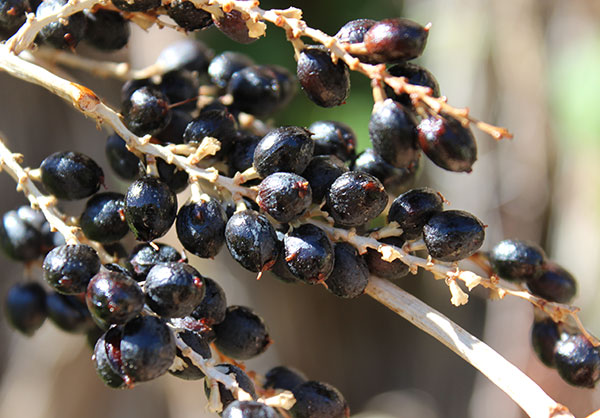
Palm tree fruit comes from fan palm species indigenous to the Southwestern U.S. and Northern Mexico.
Desert fan pan is, in fact, America's largest native palm variety and has served as a dietary mainstay and material resource for specific American Indian populations, like the Cahuilla of the inland regions of Southern California.
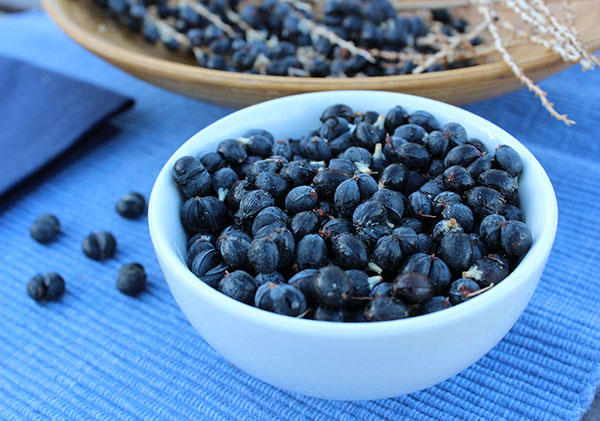
Certain types of fan palms are immediately recognizable by their wide trunks that are usually petticoat-covered with large dried palm leaves. They also have long clustered strands of dark blue fruit that grow prolifically between the early spring and fall seasons.
The thin pulp, which surrounds a light brown colored seed, makes a tasty fresh or dried snack that resembles the mineral-rich flavor of molasses and dates.
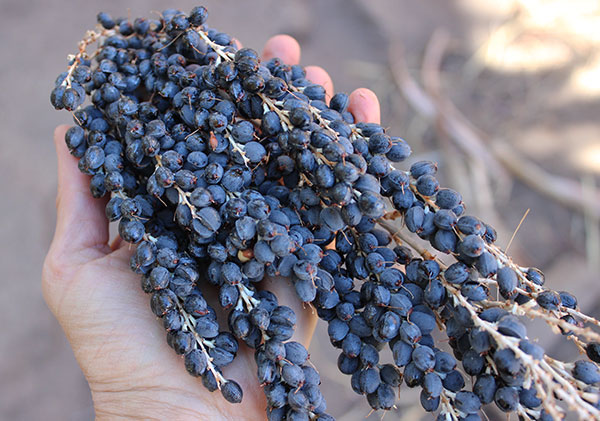
These small fruits, the size of a small blueberry, can be another wild variety alternative to add to your list of wild edibles and herbs.
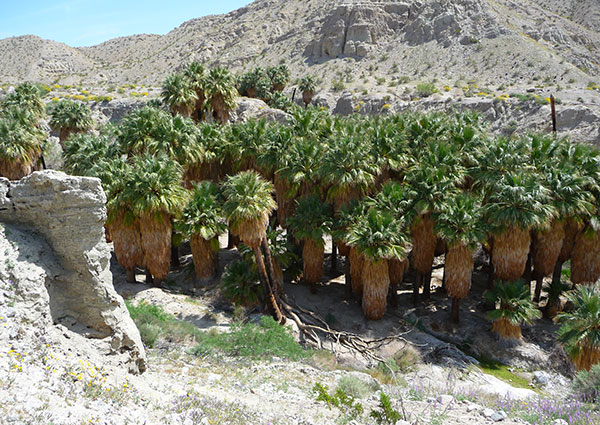
One of the best parts about wildcrafting your own palm fruit is that they are frequently growing right out of a natural desert oasis!
Entering a wild fan palm forested location is a very unique and magical experience. It is one we highly recommend adding to your "bucket list." When you consume palm fruit from these pristine canopy locations you can't help but take in the essence of this landscape.
Fan palm oases primarily exist in dry, sandy hot climates with an adequate source of fresh water, commonly located by alkaline springs, streams or rivers.
Many oases thrive when there is an underground aquifer source, which provides for the dense mineral content found in the fruits. This is often in isolated mountainous canyons, at the base of desert hills or other places where water can reach the deep root system of the trees through fault line cracks in the earth.
What is Palm Tree Fruit?
Washingtonia filifera also called California fan palm because it is specifically native to arid desert regions, particularly the Sonoran, Mojave and Colorado Desert locations of Southern California, Death Valley and Baja. Washingtonia filifera, and the closely related species Washingtonia robusta, is also naturally common in Southwest Arizona and areas of Northern Mexico.
Desert fan palms have adapted to other parts of the world including Florida and many Mediterranean climates and have naturalized to regions of Hawaii, the Virgin Islands and Australia.
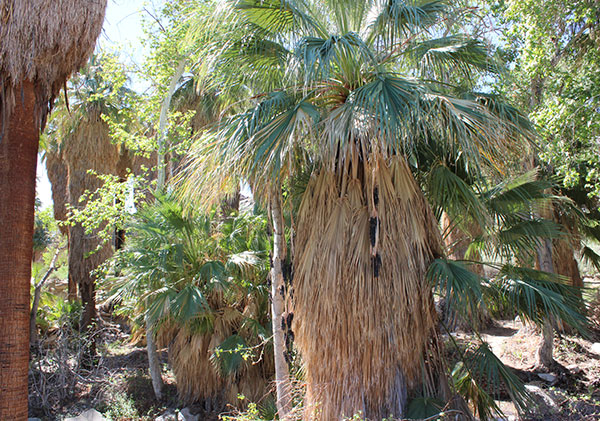
The typical featured look of the fan palm tree occurs when the large fan shaped leaves die back and bend downwards to form a skirt or petticoat around the trunk base.
Growing to heights of between 49-66 feet (15–20 meters) and 10-20 feet (3–6 meters) wide, grouped stands of fan palms provide a naturally beautiful forest canopy, utilized as a wildlife habitat and has been historically used as a shelter and food supply by native peoples and early migrating settlers.
Palm fruits develop as "infructescences" from the flowering inflorescences which eventually fall to the ground where they can be consumed by land animals. You may, in fact, notice the seedy scat droppings around fan palm groves. In Southern California they are a food source for coyotes, big horned sheep and varied other wildlife.
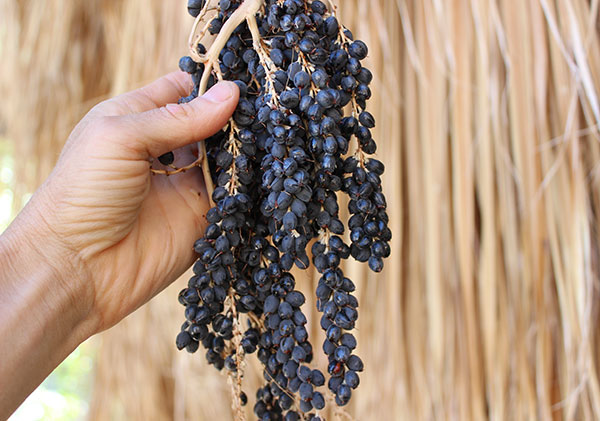
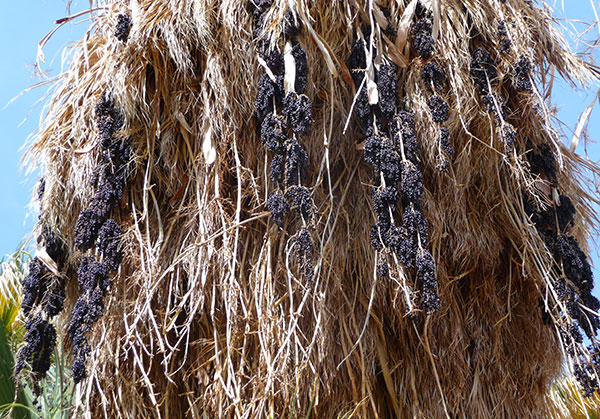
The fruits develop from the white to peach-colored flowers or branched inflorescences, which look very similar to that of the coconut palm and the blossoms used to make coconut nectar and coconut sugar.
Palm tree fruit is about the size of a small blueberry and also grows in clustered strands very similar to acai berries or red palm fruit used to make red palm oil, both varieties of which are a "tropical" palm species.
Each dark blue fruit growing off the main stem is divided into two sections, both having separate seeds.
What is the Fruit Like?
Palm tree fruits are sticky sweet dark fruits that are edible from late spring to late fall. They are not your typical juicy fruit variety but offer a thin chewy pulp that has a slightly dried texture. They are often covered with a sugary sap that tastes a lot like a combination of molasses and butterscotch.
How to Use
The fruits can be picked off the stem and consumed directly by skillfully removing the thin pulp layer and discarding the hard center seeds, much the way you would eat shelled sunflower seeds. The fruits can also be soaked, peeled off the seeds and dehydrated to dry for storage purposes.
Fresh or dried palm fruit pulp can be added to smoothies or desserts.
The fruit can be eaten Cahuilla-style as a soaked and dehydrated cake, blended into drinks or used to make jellies.
Harvesting Palm Tree Fruit
Harvesting the fruit clusters, once you have the appropriate tools, is very a satisfying experience because you can collect many strands in just a short amount of time from one or two trees.
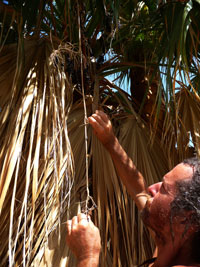
This process can be a bit of a challenge because the trees are quite tall and the fruits strands do not often hang within arm's reach. On occasion you may find one or two trees within a group that are either growing close to tall rocks to climb on or provide low hanging fruit strands that can be cut with a knife or sharp pruning shears. However, this is rarely the case for most fan palm fruit harvests.
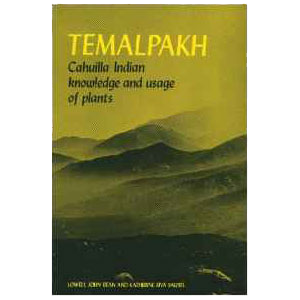
The Cahuilla Indians, as documented in the book "Temalpakh: Cahuilla Indian Knowledge and Usage of Plants", achieved this using two different methods. One was by lassoing the fruit clusters with a rope, tightly gripping the main strand and then forcefully pulling it down to the ground. A tarp can be laid underneath the tree or caught by someone waiting at the base. The second Cahuilla wildcrafting technique involved a long willow pole with a notch at the top that could hook onto the main hanging stem to effectively pull it down.
We have found, in our attempts to reach high growing fruits, however, that a long portable telescopic pruning pole works best for modern-day hiker style harvesting. The dried stems are quite thick and tough, as they need to hold the weight of many fruits. A sharp object like a knife or pruning device therefore works most appropriately.
Sometimes fan palm trees are also used as ornamental landscape plants in rural settings, parks and desert cities conductive to their growth. A ladder of course can also be another alternative method for fruit harvesting under such circumstances.
A Wild Food of Native Cultures
The fan palm tree and its fruits were highly valued as a reliable and prolifically yielding wild food source in dry and desolate desert regions, with a single strand of infructescences often weighing up to 5-20 or more pounds.
The fruits, called maul, were eaten fresh and often dried to store for future use and were beneficial as a staple dietary carbohydrate.
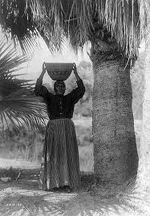
Palm tree fruit was eaten raw, cooked or ground into flour and dried as cakes by several Native American Indian populations, including both the Paiutes, Cahuilla and related tribes. The fruits were also soaked to produce a sweet beverage as well as made into a jelly.
Ground seeds, and the sweetness of the fruits, made a kind of flour that could be added with other flours, like acorn, and consumed as a mush.
The Cahuilla Indians of the Coechella Valley near Palm Springs, California extensively used all parts of the desert fan palm for food as well as a fibrous resource and building material for making rounded hut shelters, sandals, baskets, in addition to cooking and cleaning utensils. The word filifera from the species name Washingtonia filifera means "thread-bearing."
Growing Desert Fan Palms
Because of its attractive appearance and relatively low maintenance, desert fan palms are often found as a common ornamental landscape tree. These varieties are often manicured to remove the lower skirt leaves.
For those who live in sandy hot desert environments, where other palm species also thrive, Washingtonia filifera can also be propagated. It is known to be a rapidly growing species and although the trees are actually drought-tolerant they tend to thrive well with some kind of water supply. It grows best in USDA Zones 8-11.
Precautions:
It is extremely important that you positively identify any wild edible plant before you harvest and eat it. There are many poisonous and even deadly look-a-likes, so it is good to err on the side of caution and use a plant identification guide to get to know the specific wild edibles in your local area.
Shop Related Products (About Affiliates & Amazon Associate Paid Links)
Affiliate Disclaimer: This section contains affiliate product links. If you make a purchase through one of our recommended links, we will receive a small commission at no additional cost to you. Thanks for the support!